
Networks
To truly understand what a network is, let’s take a quick trip back to where it all began.
In 1969, a groundbreaking idea emerged:
What if computers could talk to each other?
That idea gave birth to ARPANET (Advanced Research Projects Agency Network). It was the first successful attempt to allow two computers to transfer messages to each other over a network. This milestone laid the foundation for what would eventually become the modern Internet.
Fast forward to 1989, when Tim Berners-Lee introduced the World Wide Web (WWW) , a user-friendly way to access and share information over the Internet. From that point on, the Internet rapidly evolved into a global platform for communication, data exchange, innovation, and collaboration, just like we know it today.
So, What Exactly Is a Network?
At its core, a network is simply a group of devices (computers, phones, printers, servers, etc.) that are connected together and able to communicate with one another.
And the Internet?
It’s essentially one giant network made up of many smaller networks — all interconnected.
Types of Networks
There are two main types of networks:
🔒 Private Network
A private network is limited to a specific group or organization.
Examples:
- Your home network — where all your personal devices connect to your Wi-Fi router.
- A company network — connecting all employee devices and internal resources.
These networks are usually protected from the public and are used for internal communication and services.
🌐 Public Network
A public network connects many private networks together — this is the Internet itself.
This type of network allows people and organizations around the world to communicate, share information, and access resources. Every website you visit or video you stream relies on this vast interconnected system.
Why Should Cybersecurity Professionals Care?
As a cybersecurity professional, understanding how networks work is fundamental. Everything from hacking techniques to defense strategies revolves around networks.
You’ll need to understand:
- How devices communicate
- The hardware involved (routers, switches, firewalls, etc.)
- The protocols and rules that govern the Internet (like TCP/IP, HTTP, DNS)
While this post is a basic introduction, the key takeaway is this:
A network is simply a collection of devices that can communicate with each other. The Internet is a global system made up of countless such networks, all connected together.
Here’s a simple visual to help you understand the concept:
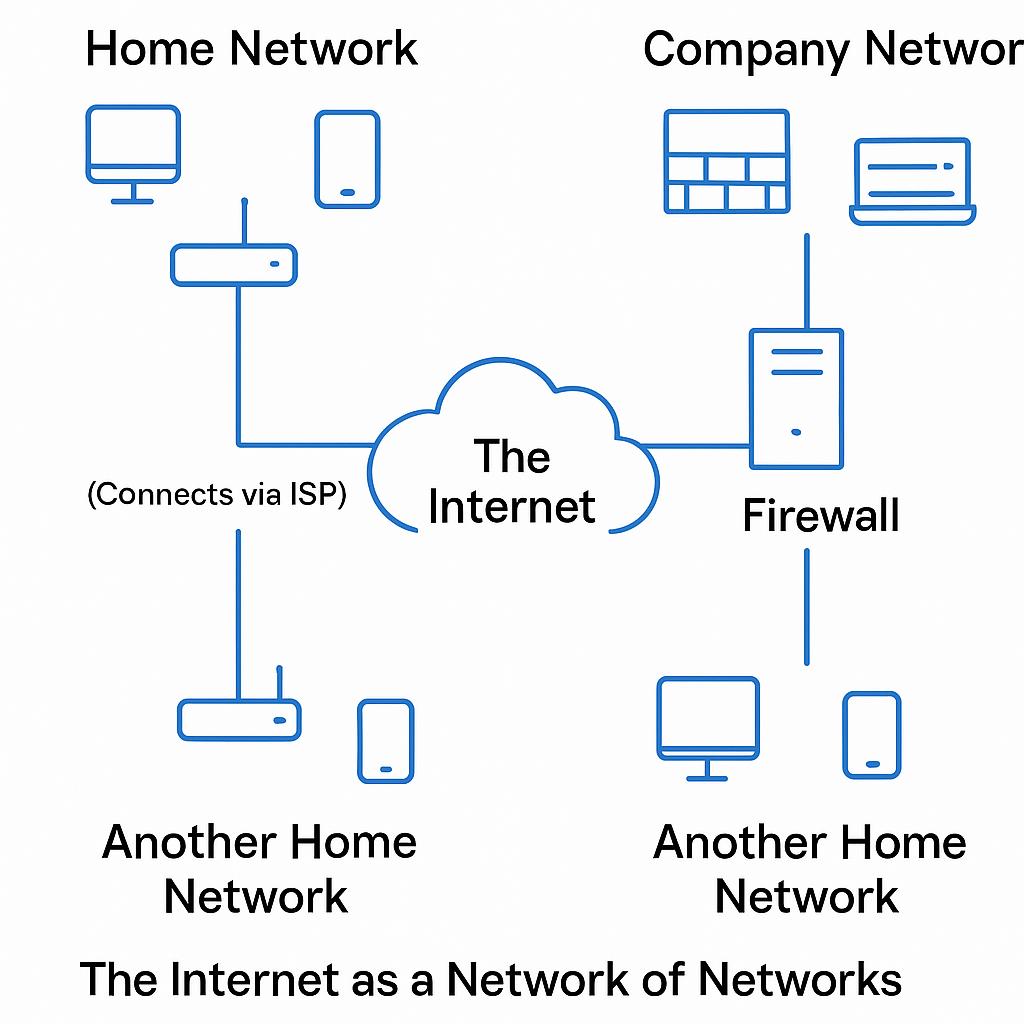
Each of these private networks communicates through the public Internet — forming a vast, interconnected system we rely on every day.