
My CompTIA Security+ Certification Review
When I first started my journey into IT, I had a long-term goal in mind: I wanted to become a penetration tester. But I also knew I couldn’t just jump straight into the deep end. I needed to build a strong foundation first — and for me, that meant following the CompTIA trifecta: A+, Network+, and finally, Security+.
Security+ was the certification I was looking forward to the most. After spending months studying the fundamentals of hardware, operating systems, and networking, I was finally stepping into the world of cybersecurity — and I was excited.
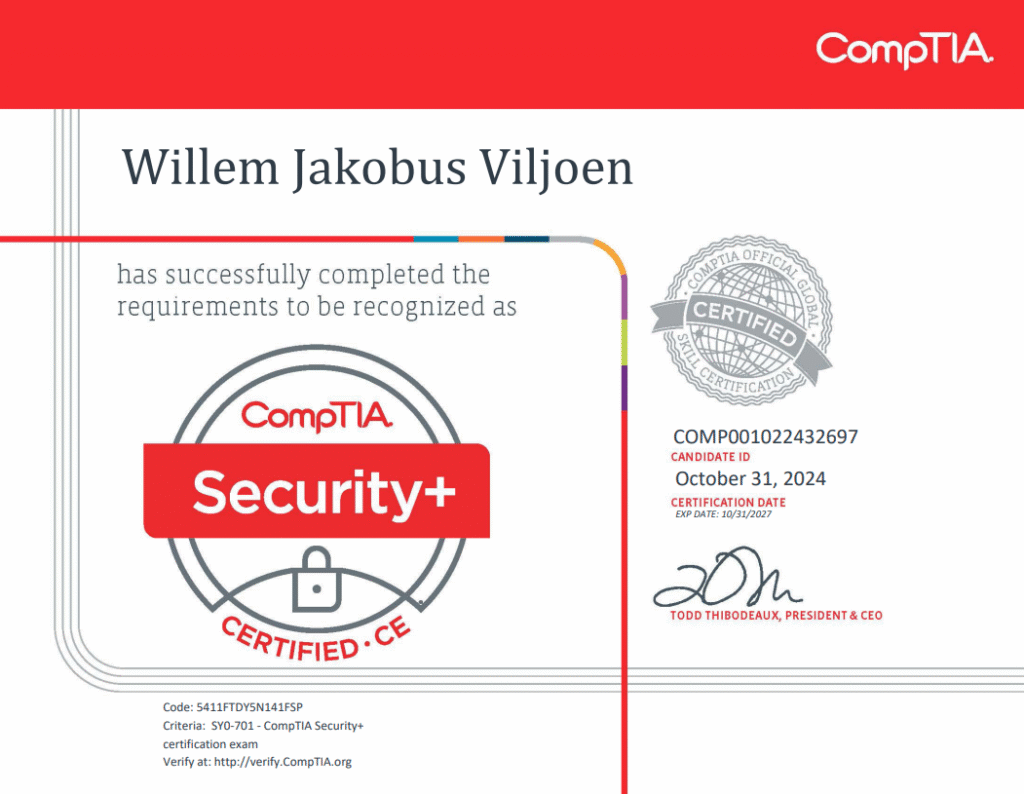
First Impressions and Experience
The Security+ lived up to my expectations. I found it engaging, valuable, and packed with knowledge I still rely on today. It’s not just a “security overview” — it’s a well-rounded introduction to the essential concepts, tools, and technologies that underpin modern cybersecurity.
You’ll cover topics like:
- Cryptography, hashing, and encryption algorithms
- Public and private key infrastructure (PKI)
- Firewalls, IDS, IPS, and other security devices
- Risk management and threat modeling
- Security policies, frameworks, and compliance
- Identity and access management
- Secure network architecture
What really stood out to me is that Security+ doesn’t just focus on red team concepts. It also introduces you to the defensive side of cybersecurity — blue teaming — helping you understand how systems are secured and monitored, and why attackers target certain vulnerabilities.
This kind of dual perspective is incredibly valuable for anyone entering offensive security. If you want to break into systems, you need to understand how they’re defended.
Why It’s Valuable for Penetration Testers
Even though Security+ is an entry-level cert, a lot of the concepts it teaches are directly relevant to penetration testing. Understanding hashing, encryption, authentication mechanisms, and access control models is crucial when you start exploiting systems or performing privilege escalation. It gives you a context for what you’re seeing on a real-world engagement.
You’ll also start to get a feel for how organizations defend their infrastructure, which helps when you’re trying to figure out how to bypass it.
So if you’re aiming for pentesting, don’t skip Security+. It’s one of the best starting points to give you that essential security mindset.
Conceptual vs Practical – Get Your Hands Dirty
CompTIA certifications have a reputation for being heavy on conceptual knowledge — and Security+ is no exception. The exam is multiple-choice, and while the topics are critical, you won’t get much hands-on experience just from studying theory.
That’s why I strongly recommend pairing your study with hands-on labs.
CompTIA now offers bundles that include labs, and while they’re a bit more expensive, the value they provide is enormous. You need to practice the concepts you’re learning — setting up firewalls, working with encryption tools, exploring real attack scenarios — to truly internalize the material.
If you’re serious about cybersecurity, don’t just read about it — do it.
Final Thoughts
Security+ was a pivotal moment in my IT journey. It took all the foundational knowledge I’d built with A+ and Network+ and brought it together with real-world cybersecurity concepts. It challenged me, inspired me, and made me even more certain that this was the path I wanted to follow.
Would I recommend it? Absolutely. Whether you want to go into red teaming, blue teaming, or just understand how to protect systems and data, Security+ gives you the groundwork to build a strong, practical cybersecurity career.
Just one piece of advice: don’t treat it as the end goal. Treat it as the beginning of a new, more technical and hands-on phase of your journey.