
My CompTIA A+ Certification Review
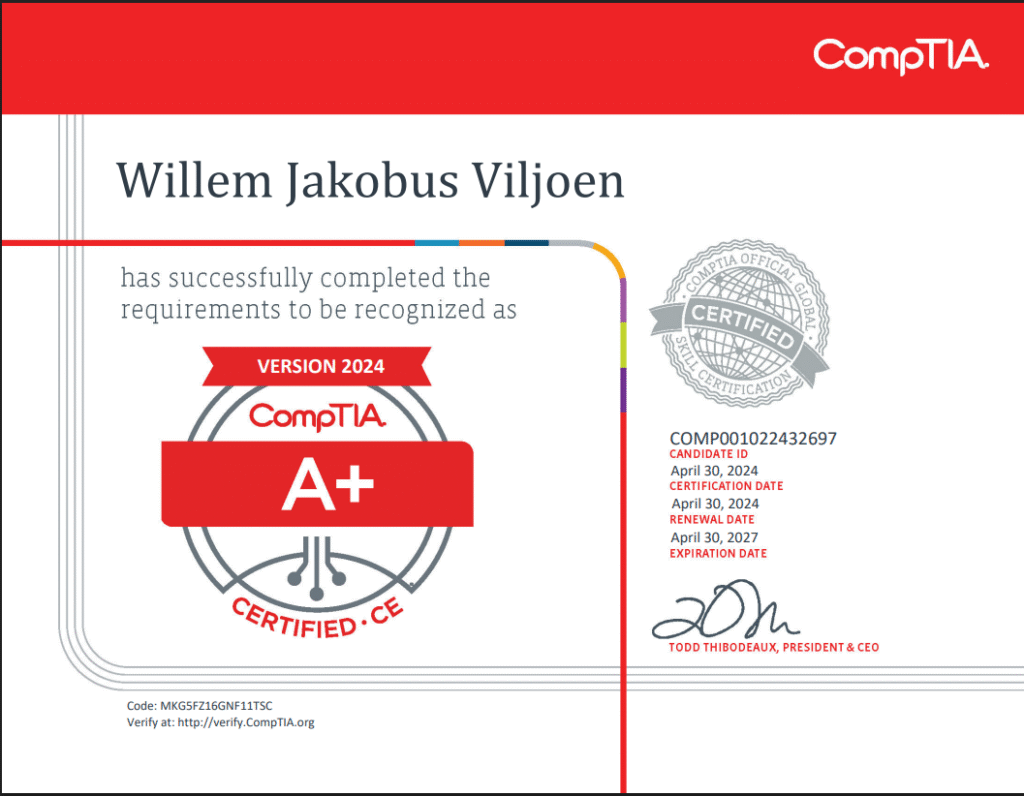
The CompTIA A+ was my first real IT certification — and it played a massive role in getting me where I am today. I didn’t come from a technical background. In fact, I only got my first computer when I was 21. Before that, I wasn’t some childhood prodigy tinkering with machines or writing code in the dark. I knew very little about IT. But when I started the A+ at 25, it completely opened up a new world for me.
I enjoyed the entire journey.
What the A+ Taught Me
The A+ consists of two exams — Core 1 (220-1101) and Core 2 (220-1102).
- Core 1 focuses on hardware: the physical components of a computer, various cables and connectors, storage types, RAM, CPUs, motherboards, BIOS/UEFI, and the basics of networking. You’ll also learn about mobile devices, printers, and how different technologies interact at a physical level.
- Core 2 leans more into software: Windows and Linux operating systems, system utilities, installation processes, command line usage, and basic cybersecurity concepts. Troubleshooting is a major focus in both exams — from diagnosing a faulty boot to resolving network issues.
One of the most satisfying moments for me was being able to confidently build my own gaming PC after passing A+. Knowing how everything fits together, what each component does, and how to troubleshoot problems — it gave me the confidence to experiment and learn even more.
The Value of a Broad Foundation
The A+ is a very broad certification. It doesn’t go deep into any one area, but that’s the point. It gives you a strong foundation in hardware, software, networking, mobile devices, and troubleshooting. You touch a bit of everything, and for someone starting out, that’s exactly what you need.
It also helps you figure out where your interests lie. After finishing A+, I had a clearer sense of what I enjoyed and what I wanted to explore further.
Conceptual vs Practical
One thing to note — like many CompTIA certifications, A+ is heavy on conceptual knowledge. It’s great for learning terminology, protocols, and theoretical understanding, but it doesn’t push you to get your hands dirty in the same way a lab-based course might.
That said, it did inspire me to get practical. I was constantly researching, tinkering, and testing what I learned — which made the experience a lot more valuable. IT is a hands-on field, and the sooner you start applying what you learn, the faster you grow.
Who Should Take the A+?
This certification is for anyone who’s completely new to IT and wants to build a solid foundation. If you’ve never:
- Built a PC or identified its internal components
- Configured a home network or understood how IP addressing works
- Navigated the Windows command line or a Linux terminal
- Understood basic troubleshooting techniques for hardware and software issues
…then the A+ is worth your time.
On the other hand, if you’re already comfortable with these things — if you can build a PC in your sleep, know your way around Linux, and understand networking basics like TCP/UDP and subnetting — then you might be ready to skip the A+ and move straight into something more advanced.
Final Thoughts
The A+ was the stepping stone I needed to break into IT. It gave me confidence, taught me how computers and networks actually work, and set me on the path toward more technical and security-focused certifications. While not everything I learned still applies to what I do now, the foundational knowledge was invaluable.
I wholeheartedly recommend it to anyone at the start of their IT journey. It’s not just a certification — it’s a mindset shift. It teaches you how to think like a technician, troubleshoot like a pro, and lay the groundwork for a future in tech.